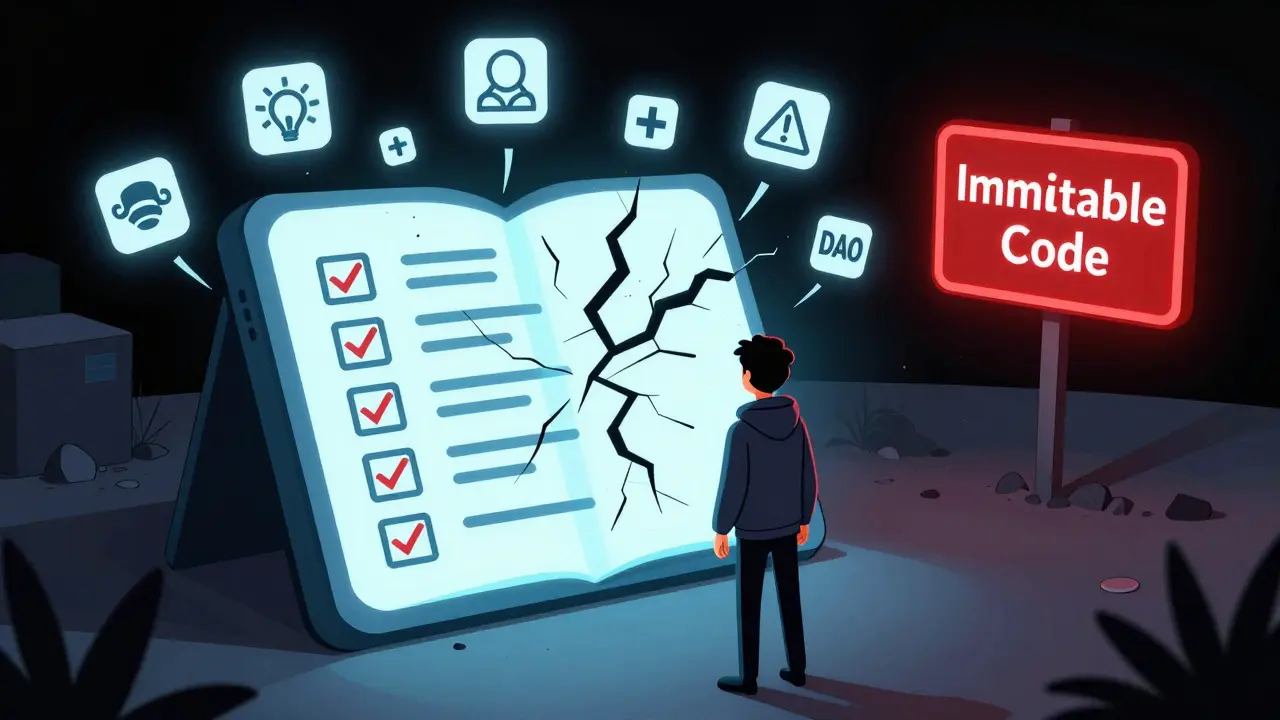
When you’re building a blockchain application, a single line of flawed code can cost millions. Unlike traditional software, where you can push a patch overnight, blockchain code is immutable once deployed. If a smart contract has a漏洞, there’s no undo button. That’s why blockchain code review isn’t just a step in development-it’s the last line of defense.
Why Blockchain Code Review Is Different
Most software teams rely on automated scanners and quick peer reviews. That’s fine for a web app. But blockchain? It’s a different world. The value locked in smart contracts can reach billions. A bug that lets someone drain funds isn’t just a bug-it’s a heist waiting to happen. Take The DAO hack in 2016. A single recursive call vulnerability let attackers steal $60 million worth of Ether. That incident didn’t just lose money. It shattered trust. Since then, every serious blockchain project treats code review like a security audit, not a code cleanup. Unlike traditional apps, blockchain systems rely on consensus mechanisms, cryptographic signatures, and decentralized logic. A reviewer needs to understand how Ethereum’s EVM executes bytecode, how Solana’s fork-free consensus works, or how Cosmos handles cross-chain messages. Generic code review tools miss these nuances. You can’t scan for reentrancy attacks if your tool doesn’t know what a function call stack looks like in Solidity.The Two Approaches: Bottom-Up vs. Top-Down
There are two main ways to review blockchain code, and they suit different experience levels. The Bottom-Up Approach is for newcomers. Start with the smallest pieces: data structures, primitive types, and utility functions. For Ethereum clients, that means looking atreth-primitives first-how addresses, hashes, and numbers are defined. Then move to reth-evm to see how transactions are parsed and executed. After that, check reth-consensus for block validation logic. Finally, examine reth-engine-api for how the execution layer talks to the consensus layer. This method builds your mental model piece by piece. Sigma Prime recommends this path because it prevents overwhelm.
The Top-Down Approach is for veterans. Start at the entry points: public functions in smart contracts, API endpoints, or external contract calls. Trace execution paths like a depth-first search. Ask: Where does user input enter? Where does money leave? What happens if a function fails? This method catches logic flaws fast-like a contract that doesn’t check if a transfer succeeded before updating state.
Most teams use a hybrid: start top-down to find the high-risk areas, then drill down with bottom-up checks.
Automated Tools Aren’t Enough
You’ll hear people say, “Just run Slither or MythX.” And yes, those tools help. But they only catch about 30-40% of vulnerabilities, according to OWASP’s Code Review Guide v2. They’re great at spotting known patterns: reentrancy, integer overflows, unchecked external calls. But they can’t find logic flaws. Imagine a token contract that lets users withdraw funds based on a timestamp. The developer thinks it’s safe because they check the time. But what if someone manipulates the block timestamp? Automated tools won’t catch that. Only a human who understands how miners control timestamps will. Use tools like SonarQube, Veracode, or OWASP ZAP to automate the low-hanging fruit. But never trust them to find the dangerous stuff. Nethermind’s 2022 research showed that 73% of smart contract vulnerabilities were logical errors-exactly what automated scanners miss.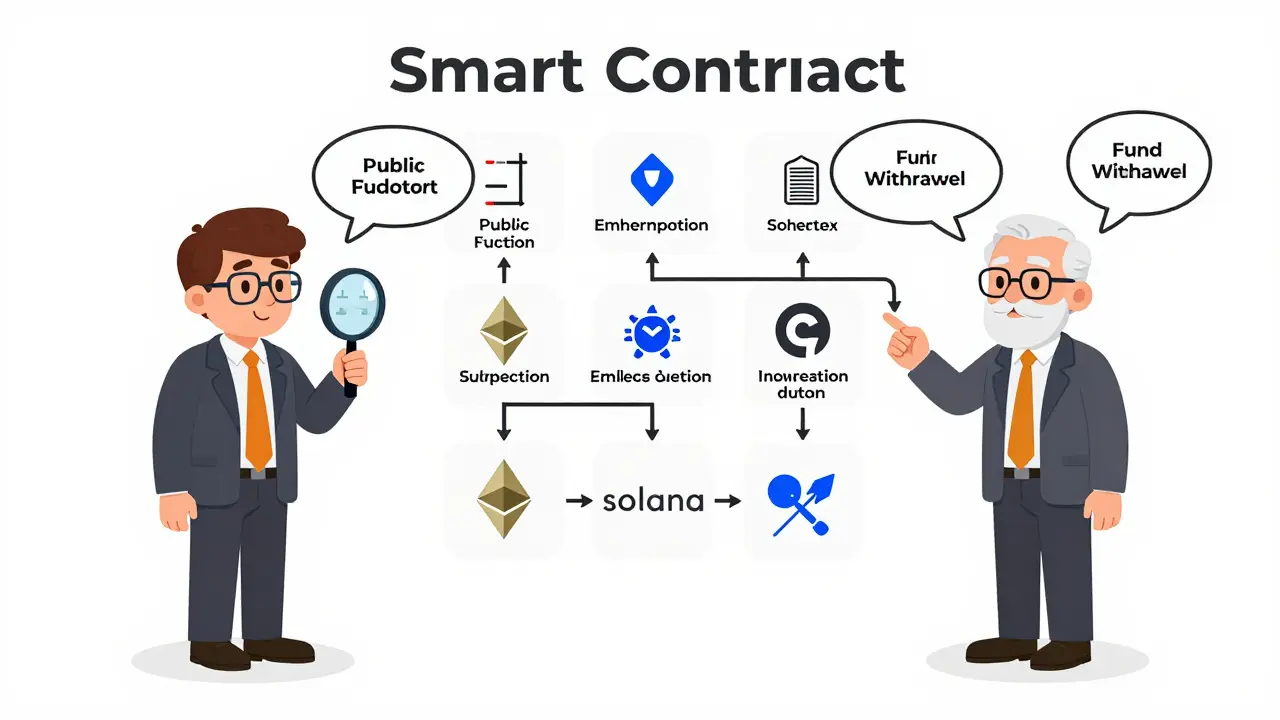
The Human Layer: Manual Review Must Lead
Manual review is non-negotiable. It’s slow. It’s expensive. But it’s the only way to catch business logic errors. Here’s what a good manual review looks like:- Trace every path a transaction can take through the contract.
- Ask: What happens if this function is called 100 times in one block?
- Check how errors are handled. Does the contract revert cleanly? Or does it leak stack traces?
- Verify all external calls use safe patterns:
call().value()with proper checks, nottransfer()alone. - Look for race conditions. Is state updated before or after an external call?
- Test edge cases: zero values, max uint256, empty arrays, reentrant calls.
Checklist for a Solid Review
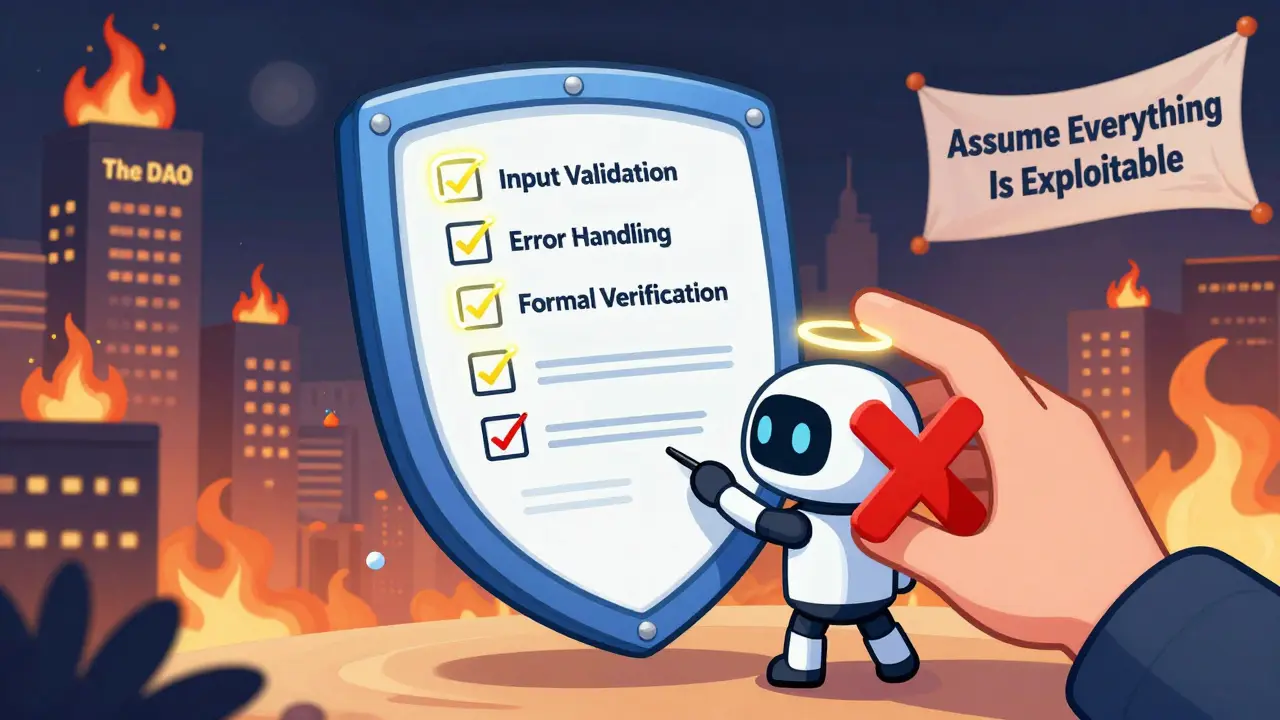
A good review isn’t random. It follows a checklist. Here’s what Devcom’s 2023 guidelines recommend:- Input validation: Are all user inputs sanitized? Are arrays bounded? Are addresses checked for zero?
- Error handling: Does the contract fail safely? Are revert messages clear? Do they avoid leaking internal state?
- Authentication: Is access control properly enforced? Are roles defined? Is there a way to escalate privileges?
- API security: Are external contracts trusted? Are calls to unverified contracts allowed?
- Infrastructure: Is the node running on hardened servers? Are RPC endpoints rate-limited? Is TLS enforced?
- Data protection: Are sensitive values encrypted at rest? Is TDE or CLE used for on-chain data?
Testing Beyond Unit Tests
Unit tests check if a function returns the right output. But blockchain needs more.- Integration testing: Do multiple contracts work together? If Contract A calls Contract B, does B handle bad input from A?
- Fuzz testing: Feed random data into functions. Try 10,000 random inputs. Can it crash? Can it drain funds? Tools like Foundry’s fuzzing engine are built for this.
- Formal verification: This is the gold standard. Tools like Certora or CertiK use mathematical proofs to show a contract behaves correctly under all possible conditions. Nethermind predicts that by 2025, 60% of high-value contracts will use this.
Who Should Review?
Not every developer can do this. Blockchain code review requires:- Deep knowledge of the blockchain protocol (Ethereum, Solana, etc.)
- Experience writing or auditing smart contracts
- Understanding of common attack patterns (reentrancy, oracle manipulation, frontrunning)
- Patience to trace execution paths manually
The Future: CI/CD and Regulation
Code review is moving into pipelines. OWASP found that 63% of blockchain teams now run automated scanners on every commit. That’s good-but not enough. Regulations are catching up. The EU’s MiCA regulation, effective in 2024, requires crypto service providers to implement standardized security assessments-including code reviews. By 2026, 101Blockchains forecasts that 75% of enterprise blockchain projects will have mandatory review processes. The message is clear: if you’re building on blockchain, you don’t get to skip this step. The cost of skipping it isn’t just technical-it’s reputational, legal, and financial.Final Rule: Assume Everything Is Exploitable
The best blockchain reviewers operate with one mindset: if it can be broken, it will be broken. There’s no such thing as “probably safe.” There’s only “tested,” “verified,” and “deployed.” Review like your life depends on it-because for someone, it might.What’s the biggest mistake in blockchain code reviews?
Relying on automated tools alone. Scanners catch only 30-40% of vulnerabilities. The rest-logic flaws, race conditions, economic exploits-are invisible to machines. Only human review, with deep protocol knowledge, can find them.
How long should a blockchain code review take?
It depends on complexity. A simple ERC-20 token might take 3-5 days. A DeFi protocol with multiple contracts, oracles, and cross-chain interactions can take 2-4 weeks. The key isn’t speed-it’s thoroughness. Rushing a review is how hacks happen.
Can I use AI or LLMs to do code reviews?
Only for initial understanding. Tools like GitHub Copilot or ChatGPT can summarize code or suggest fixes, but they don’t understand blockchain economics or attack vectors. Sigma Prime and Halborn both warn: never accept LLM suggestions without manual verification. They can hallucinate security fixes that don’t work.
What’s the difference between a code audit and a code review?
A code review is part of the development process-it’s ongoing, iterative, and done by internal or contracted engineers. A code audit is a formal, third-party assessment, usually done once before deployment. Audits are more comprehensive and often include formal verification. Most teams do both.
Why can’t blockchain code be patched after deployment?
Because blockchains are immutable by design. Once a transaction is confirmed and written to the ledger, it can’t be altered. Smart contracts are deployed as bytecode on-chain. There’s no server to update. The only fix is deploying a new contract and migrating users-a costly, risky process that breaks trust.
Is formal verification worth the effort?
For high-value contracts-like DeFi protocols holding billions in assets-yes. Formal verification uses math to prove a contract behaves correctly under every possible input. It’s expensive and slow, but it’s the closest thing to a guarantee you’ll get. Nethermind predicts over half of major contracts will use it by 2025.
What skills should a blockchain code reviewer have?
They need deep knowledge of the blockchain protocol (EVM, Solana, etc.), experience with smart contract languages like Solidity or Rust, understanding of common vulnerabilities (reentrancy, oracle manipulation), and the ability to trace complex execution paths manually. Familiarity with tools like Foundry, Slither, and MythX is helpful, but human judgment is irreplaceable.
10 Comments
Oh wow, another ‘blockchain code review is sacred’ manifesto. Let me guess-you’ve never seen a contract get hacked because someone trusted a ‘manual review’ from a guy who thinks ‘reentrancy’ is a type of yoga pose.
Automated tools catch 30-40%? Cool. So does my toaster. But at least my toaster doesn’t charge $200k to ‘audit’ a contract written in 2021 and then miss a basic unchecked transfer because it was ‘too nuanced’ for their ‘proprietary methodology.’
Formal verification? Sure, if you’re building a Mars rover. For 99% of DeFi apps? It’s like hiring a Ferrari to deliver pizza. The ROI is negative. And don’t get me started on ‘Sigma Prime recommends’ like they’re the Vatican of smart contracts.
Stop romanticizing manual review. It’s expensive, slow, and often just a placebo. The real innovation is in *predictive* static analysis-not some dude in a hoodie tracing stack pointers like he’s decoding the Voynich manuscript.
I’m genuinely concerned about how casually we’re dismissing human judgment in code review. This isn’t just about lines of code-it’s about responsibility.
When someone loses life savings because a contract didn’t check for reentrancy, it’s not a ‘bug.’ It’s a moral failure. We treat software like it’s disposable, but blockchain isn’t a mobile app. It’s digital infrastructure holding real human trust.
Yes, tools help. But no tool can understand the weight of a user’s decision to stake their entire net worth. No algorithm can feel the guilt of a developer who knew something was off but said, ‘It’ll pass the scan.’
If we’re going to build systems that hold value, we must treat them with reverence. Not efficiency. Not speed. Reverence.
And if that means slowing down? Good. We should be slowed down.
LMAO the ‘bottom-up vs top-down’ section is peak academia. You’re telling me a dev should start with ‘reth-primitives’ before touching a real contract? Bro, that’s like learning how a car engine works before you learn to parallel park.
Most devs don’t need to know how the EVM executes bytecode. They need to know: ‘Does this function let me drain the pool?’
And ‘formal verification’? That’s for people who think ‘math proofs’ fix bad architecture. I’ve seen contracts with 100% formal verification get exploited because the owner could mint unlimited tokens. The math didn’t care. The business logic did.
Stop overengineering. Review like a hacker. Break it. Don’t trace paths. Break things.
This entire post reads like a TED Talk written by a blockchain consultant who’s never shipped a line of production code.
‘Assume everything is exploitable’? Cute. That’s not a mindset. That’s a burnout recipe.
Real teams don’t have 3 weeks to review an ERC-20. They have 3 days. And if they’re lucky, they have a CI pipeline that runs Slither and MythX on every PR.
Yes, humans catch logic flaws. But so do better tools. Why not train an LLM on 10,000 past exploits? Why not use AI to simulate 10 million transaction paths in 20 minutes?
Stop glorifying manual labor. The future isn’t more reviewers. It’s smarter automation.
And yes, I’ve seen LLMs catch bugs humans missed. They hallucinate sometimes-but so do auditors.
As someone who’s worked on blockchain projects in Nigeria, India, and the U.S., I’ve seen how cultural bias shapes ‘best practices.’
In the U.S., we treat code review like a sacred ritual. In India, we ship fast and patch later-because users expect iteration, not perfection.
And in parts of Africa? We don’t even have the budget for a formal audit. So we rely on community review-open-source, public GitHub issues, and real-time Discord feedback.
Maybe the real ‘best practice’ isn’t a checklist. Maybe it’s adaptability.
One size doesn’t fit all. The blockchain world is global. Our standards should reflect that-not just Silicon Valley’s anxiety.
automated tools miss 60-70 of bugs manual review is useless too most auditors are overpaid consultants who dont understand economics the real problem is incentives miners control timestamps users dont read warnings devs dont test edge cases contracts are not code they are economic systems fix the system not the syntax
I just... I don’t know. I read this whole thing. And I’m just... 😔
It’s so much. So much pressure. So much jargon. So many checklists. So many ‘musts’ and ‘non-negotiables’.
What if... we just... built simpler things?
Not every dApp needs 17 contracts and 3 oracles.
What if we stopped trying to build the next DeFi giant and just made something that works... quietly?
I’m exhausted just reading this. 😅
Man, this post is fire 🔥
I’ve been on both sides-built a token that got hacked because we skipped review, and later worked on a project that spent 6 weeks auditing and still got reentrancy’d because someone forgot to check the return value on a call().
But here’s the truth: no one cares about your checklist if the product sucks.
Good code review isn’t about being perfect. It’s about being intentional.
Ask: ‘Who gets hurt if this fails?’
If the answer is ‘regular people with ETH they can’t afford to lose’-then yes, go full Sigma Prime.
If it’s a meme coin with 200 holders? Maybe just run Slither, test it once, and ship.
Context matters. Always.
YESSSS 😍🙌
This is EXACTLY why I left Web2 and came to blockchain.
People think it’s just crypto. But no-this is the future of trustless systems. And trust? It’s built in the code.
I’ve done 3 audits now. Two got hacked. One didn’t. Why? The one that didn’t had a dev who stayed up for 72 hours tracing every path. No tool. Just sweat.
So yeah-tools help. But nothing replaces the human who says, ‘Let me check this one more time.’
Keep doing the work. 💪✨
P.S. Formal verification is the future. I’m learning it now. 2025 is gonna be wild 🚀
What if the goal isn’t to prevent every exploit-but to make exploitation so costly and visible that it’s not worth it?
Blockchain isn’t about perfection. It’s about transparency.
Every line of code is public. Every transaction is recorded. Every flaw, once found, becomes a lesson for the next team.
Maybe the ‘best practice’ isn’t a checklist or a manual review.
Maybe it’s a culture of openness: publish your code, invite scrutiny, document your failures, and let the community grow stronger together.
We don’t need more gatekeepers.
We need more learners.