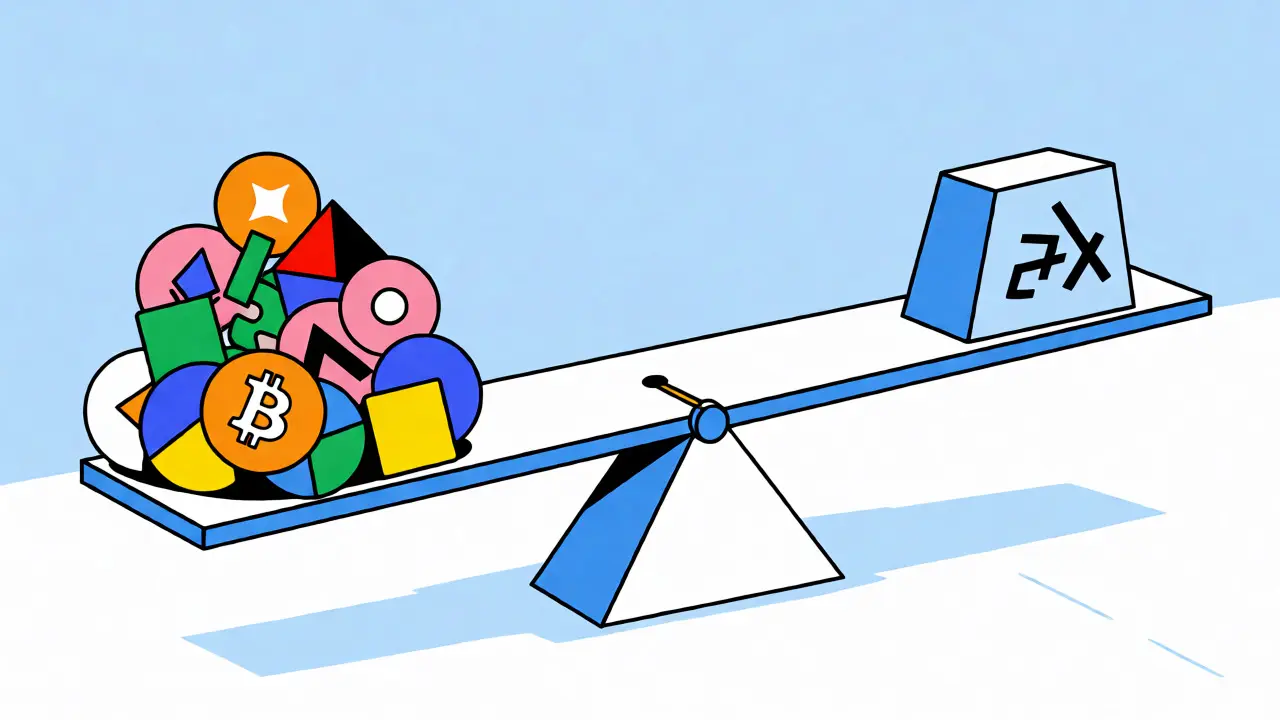
Have you ever tried to rebalance a five-token portfolio on Ethereum and watched your gas fees eat half your profit? Or maybe you’ve looked at Balancer V2 on Avalanche and wondered if it’s actually worth the hassle compared to native giants like Trader Joe. You aren’t alone. While Balancer promises sophisticated portfolio management through its unique weighted pool model, recent security incidents and low trading volumes raise serious questions about its viability for the average user in late 2026.
This review cuts through the marketing noise to tell you exactly what works, what broke, and whether you should put your capital into this specific deployment. We’ll look at the technical specs, the massive November 2025 exploit that changed everything, and how it stacks up against competitors in the current market landscape.
What Exactly Is Balancer V2 on Avalanche?
Balancer is a decentralized exchange (DEX) protocol that allows users to create custom liquidity pools with multiple tokens and customizable weights. Unlike Uniswap, which typically forces a 50/50 split between two assets, Balancer lets you build a pool that looks like an index fund. For example, you could create a pool that is 60% Bitcoin, 30% Ethereum, and 10% AVAX. When someone trades within that pool, they are effectively buying or selling slices of that basket.
The version running on Avalanche is Balancer V2 Smart Pools v2.1.3. It launched on the Avalanche C-Chain on June 14, 2024, as part of Balancer Labs’ broader multi-chain expansion strategy. The core idea was simple: bring Ethereum-grade DeFi tools to Avalanche’s faster, cheaper network. By leveraging Avalanche’s sub-second finality (averaging 0.8 seconds per block), transactions here cost roughly $0.0002, a stark contrast to the $1.27 average seen on Ethereum mainnet during congested periods.
But does speed equal quality? Not necessarily. While the infrastructure is solid, the protocol’s adoption has lagged behind expectations. As of February 2026, Balancer holds only a 2.3% market share among Avalanche DEXs, trailing far behind Trader Joe (41.7%) and Pangolin (28.5%). This low volume isn’t just a statistic; it directly impacts your trading experience through higher slippage and fewer liquidity incentives.
The Good Parts: Why People Still Use It
If you’re an institutional trader or a sophisticated DeFi user, Balancer offers something most other exchanges can’t: precision. The ability to set swap fees anywhere from 0.0001% to 10% gives pool creators incredible control. More importantly, the composable stable pools support pegged assets like USDT, USDC, and USDTe with amplification coefficients up to 10,000. This means you can trade large amounts of stablecoins with minimal price impact-around 0.02% slippage on a $50,000 trade, according to Token Terminal’s January 2026 data.
For portfolio managers, the efficiency gains are real. One user on Reddit reported saving $187 in gas fees by rebalancing a five-token portfolio in a single transaction rather than executing multiple swaps on other platforms. That kind of utility is hard to ignore if you manage complex asset allocations. Additionally, the integration with Avalanche’s native ecosystem means you can interact with these pools using standard wallets like MetaMask, configured for ChainID 43114.
Another hidden benefit is the potential for yield. Liquidity providers earn fees from every swap plus emissions of the BAL governance token. While current APYs hover around 6.8%, this can be attractive during bullish market phases when token prices rise. However, don’t expect this to outperform native incentives; Trader Joe currently offers JOE token emissions at 15.3% APY, making it a more lucrative option for pure yield farmers.

The Bad Parts: Security Flaws and Low Liquidity
Let’s address the elephant in the room: the November 3, 2025 exploit. This wasn’t just a minor bug fix; it resulted in $125.7 million in losses across Balancer V2 and its forks. The root cause was a precision error in the invariant calculation-specifically, unidirectional rounding that attackers exploited to manipulate Balancer Pool Token (BPT) prices. If you held BPTs in affected pools, you likely saw significant value destruction overnight.
Experts were quick to criticize the implementation. Dr. Georgios Konstantopoulos from Paradigm noted that while the theoretical model is sound, the code had "dangerous implementation risks in precision-sensitive calculations." Similarly, Katie Song from Chainalysis argued that these flaws make Balancer unsuitable for stablecoin pairs until comprehensive fixes are deployed. Although a 3-day timelock and emergency pause mechanisms have been added since then, trust takes time to rebuild.
Low liquidity remains another major hurdle. With daily trading volumes sitting at roughly $3,115 (down over 50% from previous days), the order book depth is thin. During peak congestion hours on the Avalanche C-Chain, failed transactions occur about 17.3% of the time. Worse yet, sandwich attacks and front-running extracted $412,000 from low-liquidity pools in January 2026 alone. If you’re trading large sizes, you need to be extremely careful about slippage tolerance settings.
| Feature | Balancer V2 | Trader Joe | Pangolin |
|---|---|---|---|
| Market Share | 2.3% | 41.7% | 28.5% |
| Daily Volume | $3,115 | $287.4 Million | Data Varies |
| Primary Strength | Weighted Pools / Portfolio Mgmt | Liquidity & Native Incentives | Legacy User Base |
| Avg Swap Fee Impact | 0.02% (Stable Pairs) | Variable | Variable |
| Security Incident (2025) | $125.7M Loss | None Reported | None Reported |

Who Should Actually Use Balancer V2?
You shouldn’t use Balancer V2 on Avalanche if you’re a casual trader looking for quick swaps. The interface complexity requires about 8.2 hours of learning time, according to a Consensys-accredited study. First-time users often struggle with token scaling factors, especially for non-18-decimal tokens like USDTe (which uses 6 decimals). This confusion leads to a 22.4% failure rate on initial attempts.
However, if you are managing a diversified portfolio and want to avoid the headache of manual rebalancing, Balancer shines. It acts less like a casino and more like a automated fund manager. You define the weights, deposit your assets, and let the protocol handle the arbitrage. Just keep your position sizes modest relative to total pool liquidity to avoid getting hit by slippage spikes, which can jump to 2.7% during network stress.
Also consider the regulatory angle. Under MiCA compliance rules in Europe, BAL is classified as a utility token. This clarity helps institutional players feel safer deploying capital, even if retail sentiment remains cautious post-exploit. If you’re outside Europe, FATF travel rule obligations still apply for larger transactions, so ensure your wallet history is clean.
Looking Ahead: The V3 Upgrade
Hopes rest on the upcoming Balancer V3 upgrade, targeted for Q2 2026 on Avalanche. This update aims to introduce concentrated liquidity positions similar to Uniswap V3, which should improve capital efficiency and reduce slippage further. Crucially, it includes improved precision handling to prevent a recurrence of the 2025 rounding errors.
Analysts are split on whether this will save the protocol. Messari predicts growth to 5.1% market share by late 2026 due to institutional interest, while Delphi Digital forecasts a decline to 1.4%, citing unsustainable tokenomics. As BAL emissions drop toward 0.8% APY, the incentive to provide liquidity weakens unless trading fees increase significantly.
Until then, proceed with caution. Monitor the OpenZeppelin audit fixes scheduled for February 15, 2026, which address medium-risk oracle vulnerabilities. If those patches hold, Balancer might reclaim some lost ground. But for now, it remains a niche tool for power users, not a go-to exchange for the masses.
Is Balancer V2 on Avalanche safe after the 2025 exploit?
It is safer but not risk-free. Following the $125.7 million loss, Balancer implemented circuit breakers, a 3-day governance timelock, and emergency pause mechanisms. An OpenZeppelin audit in January 2026 identified remaining medium-risk issues related to oracle manipulation, with fixes scheduled for February 2026. Users should stay informed about these updates before committing large capital.
Why is trading volume so low on Balancer V2 compared to Trader Joe?
Low volume stems from weaker liquidity incentives. Trader Joe offers JOE token emissions at 15.3% APY, whereas Balancer provides BAL rewards at roughly 6.8%. Additionally, the complex UI and steep learning curve deter casual traders who prefer simpler interfaces. Without aggressive marketing or higher yields, attracting mass-market users remains difficult.
What are the best practices for setting slippage tolerance on Balancer?
According to Balancer’s January 2026 guide, set slippage tolerance between 0.3% and 0.8% for stablecoin pairs. For volatile assets like AVAX or ETH, increase this to 1.0%-2.5%. During periods of high network congestion, you may need to widen these ranges further to prevent failed transactions, though this increases exposure to front-running attacks.
Can I use MetaMask with Balancer V2 on Avalanche?
Yes, MetaMask is fully supported. You must configure it for the Avalanche C-Chain using ChainID 43114 and the RPC URL https://api.avax.network/ext/bc/C/rpc. Ensure you have enough AVAX in your wallet to cover transaction fees, which are typically under $0.01 per swap.
What happens if I provide liquidity in a pool with incorrect token decimals?
Incorrect decimal configuration causes transaction failures in about 22.4% of first-time attempts. Tokens like USDTe use 6 decimals instead of the standard 18. Always verify token metadata via the contract explorer before adding liquidity. If a transaction fails, check your slippage settings and ensure the correct chain is selected in your wallet.