
Crypto Seizure Impact Calculator
Strategic Bitcoin Reserve Impact Estimator
The U.S. Strategic Bitcoin Reserve holds seized crypto instead of selling immediately. See how much value is retained when governments hold assets versus selling during market dips.
Enter values above to see how much you'd lose by selling immediately versus holding long-term.
When the U.S. government quietly added over 207,000 Bitcoin to a secret digital vault in March 2025, it wasn’t stockpiling for a doomsday scenario. It was building a Strategic Bitcoin Reserve-a new kind of national asset, funded entirely by seized cryptocurrency. This wasn’t a policy tweak. It was a revolution in how governments treat digital money after it’s been stolen, laundered, or used in crimes.
For years, law enforcement seized Bitcoin, Ethereum, and other crypto assets from drug cartels, ransomware gangs, and dark web marketplaces. Then they sold them off fast-to avoid price drops, to fund operations, to clean up the books. But in 2025, that changed. The U.S. stopped selling. Instead, it started holding. And other countries are watching closely.
Why Countries Are Seizing Crypto Now More Than Ever
In the first half of 2025 alone, criminals stole over $2.17 billion from crypto users worldwide. That’s more than all of 2024. And it’s not random. The thefts are concentrated. The U.S., Germany, Russia, Canada, Japan, Indonesia, and South Korea had the most victims by volume. But when you look at how much each victim lost on average, places like the UAE, Chile, India, Lithuania, Iran, Israel, and Norway top the charts. These aren’t just tech-savvy users-they’re high-value targets.
Why now? Because crypto is no longer just a fringe experiment. It’s woven into global finance. Stablecoins like USDC and USDT move trillions. DeFi protocols hold billions in locked assets. NFTs are used for money laundering. And criminals are getting smarter. They’re using mixers, cross-chain bridges, and decentralized exchanges to hide their trail. So governments had to adapt-or get left behind.
The U.S. Leads With a Bold New Strategy
The U.S. didn’t just seize more crypto in 2025. It changed the rules entirely. The Strategic Bitcoin Reserve, launched under an executive order from the Trump administration, now holds over $17 billion in confiscated digital assets. This isn’t a storage locker. It’s a sovereign investment fund. The goal? Avoid flooding the market with seized Bitcoin and crashing prices. Instead, hold it. Let it appreciate. Use it as a hedge against inflation. And when needed, tap into it to fund investigations, pay victims, or even buy more gold to trade for more Bitcoin.
Behind the scenes, agencies like the SEC and CFTC shifted from chasing violators to building compliance. The Crypto Task Force was relaunched. A new Cyber and Emerging Technologies Unit was created. Rules clarified what counts as a security, what’s a commodity, and how exchanges must verify users. Circle, issuer of USDC, went public. Coinbase kept trading on Nasdaq. The message? Crypto isn’t going away. The government wants to control it-not ban it.
Europe’s Focus: Ethereum and Stablecoins
While the U.S. leads in Bitcoin seizures, Europe dominates in Ethereum and stablecoin confiscations. Why? Because Europe’s crypto ecosystem is built on DeFi and tokenized assets. Stablecoins are used for everyday payments in places like Germany and the Netherlands. Ethereum powers smart contracts for everything from insurance to supply chains. When criminals move money through these systems, they leave bigger digital footprints.
In 2025, the Spanish Guardia Civil pulled off one of the biggest cross-border crypto takedowns ever-working directly with the FBI and FinCEN. They froze over $800 million in ETH and USDC linked to a ransomware ring operating out of Eastern Europe. The operation used blockchain analytics tools that could trace transactions across 17 different blockchains. It wasn’t luck. It was precision.
Other European countries are following suit. France created a dedicated Digital Asset Recovery Unit. The UK’s NCA now has a blockchain forensics lab in London. Even traditionally cautious countries like Austria and Belgium are updating their forfeiture laws to include crypto as “property,” just like real estate or cash.

Asia: Adoption Outpaces Regulation
Asia is a mixed bag. Japan and South Korea have clear rules. Exchanges must register. Assets can be seized under anti-money laundering laws. But in places like Indonesia and Vietnam-two of the world’s top crypto adopters-regulation is still catching up.
Vietnam ranked sixth in the 2025 Global Crypto Adoption Index. Millions use crypto to send money home or protect savings from inflation. But when authorities seize crypto there, it’s often unclear what happens next. Is it sold? Locked? Returned? No public system exists. That’s why criminals target these markets: low enforcement, high adoption.
China, meanwhile, banned crypto trading years ago. But that didn’t stop people from using it. Seizures still happen-mostly through bank account freezes tied to crypto purchases. The government doesn’t track Bitcoin wallets. It tracks bank transfers. So even in a ban-heavy country, crypto flows under the surface, and seizures happen quietly.
Where Crypto Is Legal-But Still Seizable
Here’s the twist: in many countries, owning crypto is perfectly legal. But if you’re caught using it for crime, they’ll take it anyway.
In Mauritius, crypto is a regulated asset under the Financial Services Act. You can buy, sell, trade. But if the police link your wallet to a fraud scheme, they can freeze it. Same in South Africa. The central bank says Bitcoin has “no legal status,” but the tax office treats it as an intangible asset. If you don’t report gains, they can seize it for tax evasion.
Angola? Fully legal. No laws against it. But officials warn citizens not to use it. Why? Because they can’t track it. If a crime happens, they can’t recover the assets. So they don’t seize. They just watch.
Namibia is the opposite. The central bank outright banned exchanges and crypto payments. If you’re caught trading, your wallet can be seized-and you could face fines or jail. No gray area.
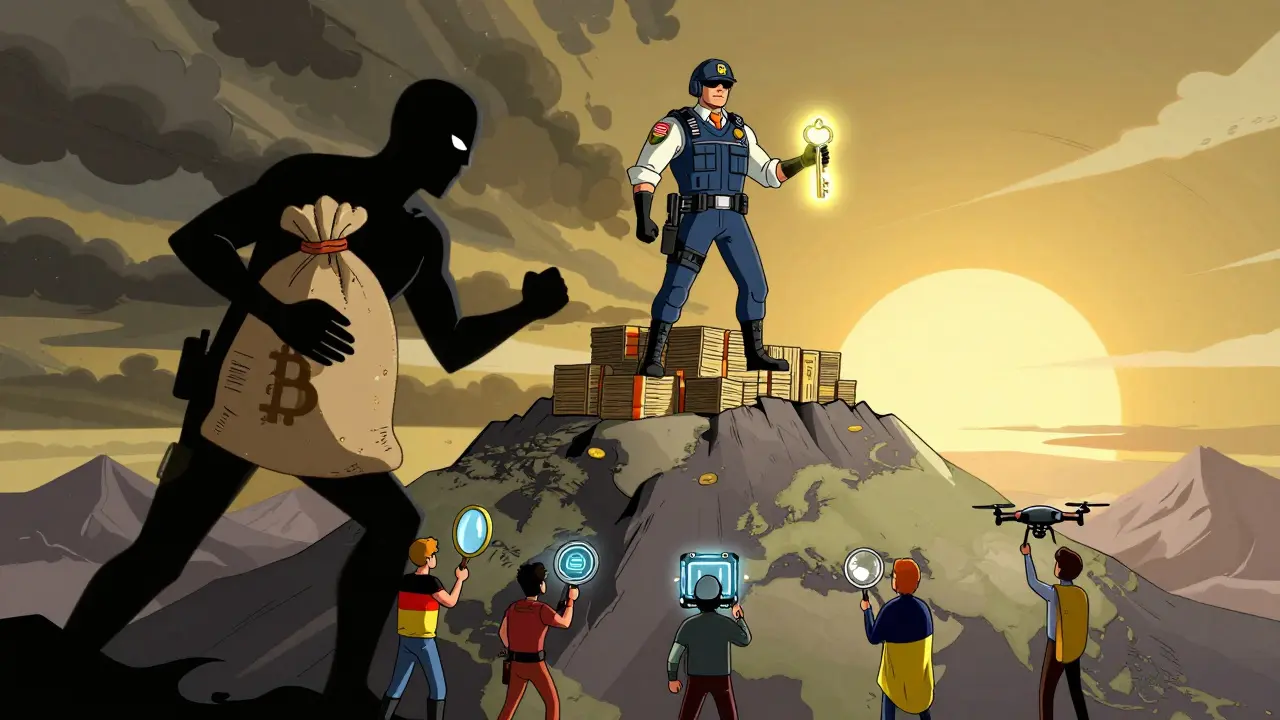
The Global Pattern: Who’s Winning the Crypto Seizure Game?
It’s not about how much crypto a country has. It’s about how well it can trace, freeze, and hold it.
The U.S. leads in total value seized-by far. But in terms of efficiency, countries like Estonia and Singapore are ahead. They use AI-driven blockchain analysis tools that can map transaction flows in minutes. They don’t need warrants for every wallet. They use court-approved algorithms to flag suspicious addresses automatically.
Eastern Europe, the Middle East, and Central Asia saw the fastest growth in crypto thefts from 2024 to 2025. That’s not because people there are more criminal. It’s because they’re adopting crypto fast-and enforcement hasn’t kept up. Ukraine, which leads the Global Crypto Adoption Index, also has one of the most active crypto seizure units in the world. After Russia’s invasion, Ukraine began seizing crypto from Russian-linked wallets and using it to fund defense. They didn’t wait for permission. They acted.
Sub-Saharan Africa has the lowest total value stolen-not because crypto isn’t used, but because most users don’t hold large amounts. When thefts do happen, recovery is rare. No forensic teams. No blockchain analysts. Just lost wallets and silent victims.
What Happens to Seized Crypto?
Most countries used to sell seized crypto within 30 days. The U.S. did it to avoid market impact. But now, the Strategic Bitcoin Reserve holds most of it. A small portion goes to victims. A portion funds law enforcement. The rest? Held long-term.
Some countries, like Germany and the Netherlands, are testing “stake and seize.” They take seized Ethereum, stake it on the network, earn rewards, and use the yield to fund investigations. It’s a way to make seized crypto work for them instead of just sitting idle.
Others, like Brazil and India, still liquidate quickly. They need cash now. But they’re losing money. Bitcoin in 2023 was $30K. In 2025, it’s $90K. Selling early means leaving billions on the table.
The Big Question: Is This Fair?
Not everyone agrees with these tactics. Critics say seizing crypto without a conviction violates due process. In the U.S., you can lose your Bitcoin even if you’re never charged with a crime-just if the government thinks it’s connected to illegal activity. No trial. No jury. Just a judge reviewing transaction data.
That’s legal under current forfeiture laws. But it’s changing. In 2025, the U.S. Congress began drafting new rules to require higher proof of connection before seizure. Some states are already requiring warrants for wallet access. The EU is pushing for a Digital Asset Forfeiture Charter to standardize rights across member states.
For now, the trend is clear: governments see crypto not as a threat to be crushed-but as an asset to be controlled. And the ones who understand blockchain best? They’re winning.
Can the government take my cryptocurrency if I haven’t broken any laws?
Yes, in some countries-including the U.S.-law enforcement can seize crypto assets if they believe the funds are linked to criminal activity, even if you’re never charged or convicted. This is called civil asset forfeiture. The burden of proof shifts to you to show the assets are clean. Many legal experts argue this violates due process, and new reforms are being considered to require stronger evidence before seizure.
Which countries are best at seizing and tracking crypto?
The U.S., Germany, Singapore, Estonia, and the UK lead in crypto seizure effectiveness. They use advanced blockchain analytics tools, have specialized cyber units, and share data internationally. The U.S. Strategic Bitcoin Reserve and Germany’s blockchain forensics labs are among the most sophisticated in the world. Countries like Singapore and Estonia combine AI, legal clarity, and cross-border cooperation to trace and freeze assets quickly.
Why is the U.S. holding onto seized Bitcoin instead of selling it?
The U.S. created the Strategic Bitcoin Reserve to avoid flooding the market with seized Bitcoin, which could crash prices. Holding it allows the government to benefit from potential price appreciation. It also creates a long-term reserve asset that can fund future investigations, pay victims, or even be used as collateral. Selling too soon meant losing billions-Bitcoin rose from $30K in 2023 to over $90K in 2025.
Can I get my seized crypto back?
It’s possible, but difficult. You need to prove ownership and that the assets weren’t involved in illegal activity. In the U.S., you must file a claim in federal court and provide evidence like wallet keys, transaction history, and proof of legal acquisition. Most people don’t have the resources or legal support to do this successfully. Some countries, like the Netherlands, have faster restitution processes for victims of hacks or scams.
Are NFTs and DeFi tokens also subject to seizure?
Yes. Courts in the U.S., UK, and EU have ruled that NFTs and DeFi tokens qualify as property under existing forfeiture laws. In 2025, the U.S. Department of Justice seized a collection of NFTs linked to a money laundering scheme involving $12 million in ETH. DeFi protocols aren’t immune-authorities can freeze wallet addresses connected to illicit activity, even if the protocol itself is decentralized.
What happens to crypto seized in countries that ban it entirely?
In countries like China or Namibia, where crypto is banned, seized assets are often destroyed, locked indefinitely, or transferred to state-controlled wallets. There’s no public system for restitution or sale. Authorities rarely disclose what happens to the assets. In practice, seized crypto in these countries is often lost to bureaucracy or used as leverage in political cases, not financial recovery.
5 Comments
This is actually kind of a game changer. Holding onto Bitcoin instead of dumping it makes so much sense financially. I mean, why sell low when you can let it grow? The government’s basically becoming the world’s biggest HODLer now. And honestly? I’m okay with that.
broooo is this like… the government just became a crypto whale?? 🤯 like imagine if they just sat on it and let it go to 500k?? but also… who gave them the right to take it if you didn’t even get convicted?? like i’m not saying i’m a criminal but what if i just bought some btc before a sketchy guy used it?? 😭
There’s something deeply human here - we’ve always feared what we can’t control, and crypto was the last frontier. Now governments aren’t fighting it… they’re learning it. The U.S. isn’t just seizing assets - they’re learning how to speak blockchain. Germany’s staking ETH? That’s not law enforcement. That’s financial evolution. And the fact that places like Ukraine are using seized crypto to fund defense? That’s not policy. That’s survival. We’re watching history rewrite itself in hexadecimal.
So if I buy crypto and someone else uses it for bad stuff later, they can take it? That feels wrong. Like, what if I got it from a legit exchange? I didn’t do anything. I just wanted to save money. This feels like punishment without a trial. I get they need to stop crime, but not at the cost of everyone’s trust.
How quaint. The U.S. is now a sovereign Bitcoin hedge fund. How very… capitalist. Meanwhile, the EU is using blockchain analytics like it’s a tax audit. And you call this progress? This isn’t innovation - it’s institutional colonization of decentralized technology. The moment you turn crypto into a state asset, you erase its entire purpose. You didn’t tame the wild west. You just built a new fort and called it law.