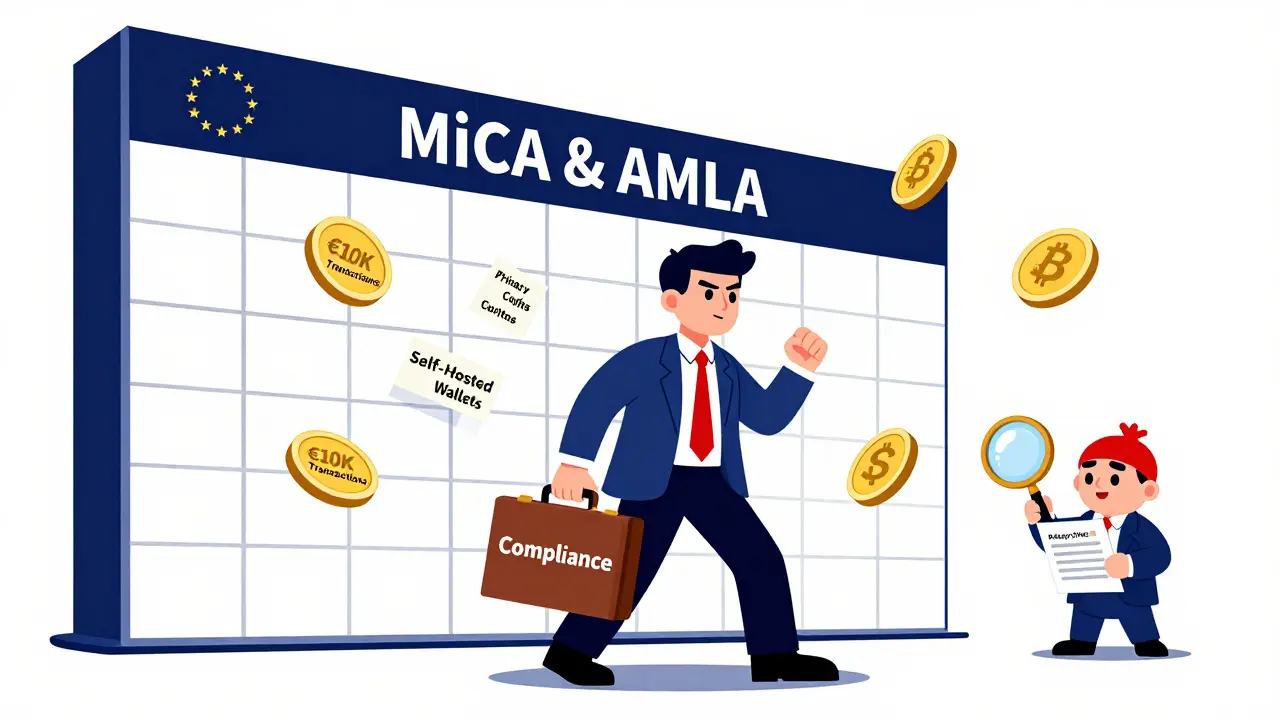
If you run a crypto business in the European Union, you’re not just dealing with technology-you’re navigating one of the strictest financial compliance systems in the world. Since 2020, the EU has been steadily tightening the screws on cryptocurrency firms, and by 2026, there’s no such thing as operating in the gray area. The rules are clear, enforced, and backed by a new supranational authority that doesn’t take excuses. This isn’t about slowing innovation. It’s about cutting off the flow of dirty money through digital assets.
Who Exactly Needs to Comply?
Any business that handles crypto assets in the EU must register and follow the rules. That includes exchanges that trade crypto for euros or other fiat currencies, wallet providers that hold crypto on behalf of customers, and even decentralized finance (DeFi) platforms that act like banks-offering lending, staking, or trading services. The key is whether you’re acting as a crypto-asset service provider (CASP). If you’re facilitating transfers, custody, or trading for others, you’re caught under the net.
It’s not enough to be based in the EU. If your customers are EU residents, you’re subject to these rules-even if your servers are in Singapore or your legal entity is in the Cayman Islands. The EU doesn’t care where you’re incorporated. They care where your users are.
The Core Rules: What You Must Do
There are five non-negotiable requirements for every crypto business operating in the EU:
- Customer Due Diligence (CDD) - You must verify the identity of every customer. For small transactions under €1,000, basic info like name and address is enough. For anything above €1,000, you need a government-issued ID and proof of address. For transactions over €10,000, you must dig deeper: where did the money come from? What’s the source of funds? And who’s the ultimate owner? No exceptions.
- Transaction Monitoring - Every crypto transfer, no matter how small, must be tracked. Your system must flag unusual patterns: sudden large deposits, rapid movement between wallets, or repeated small transfers designed to avoid detection.
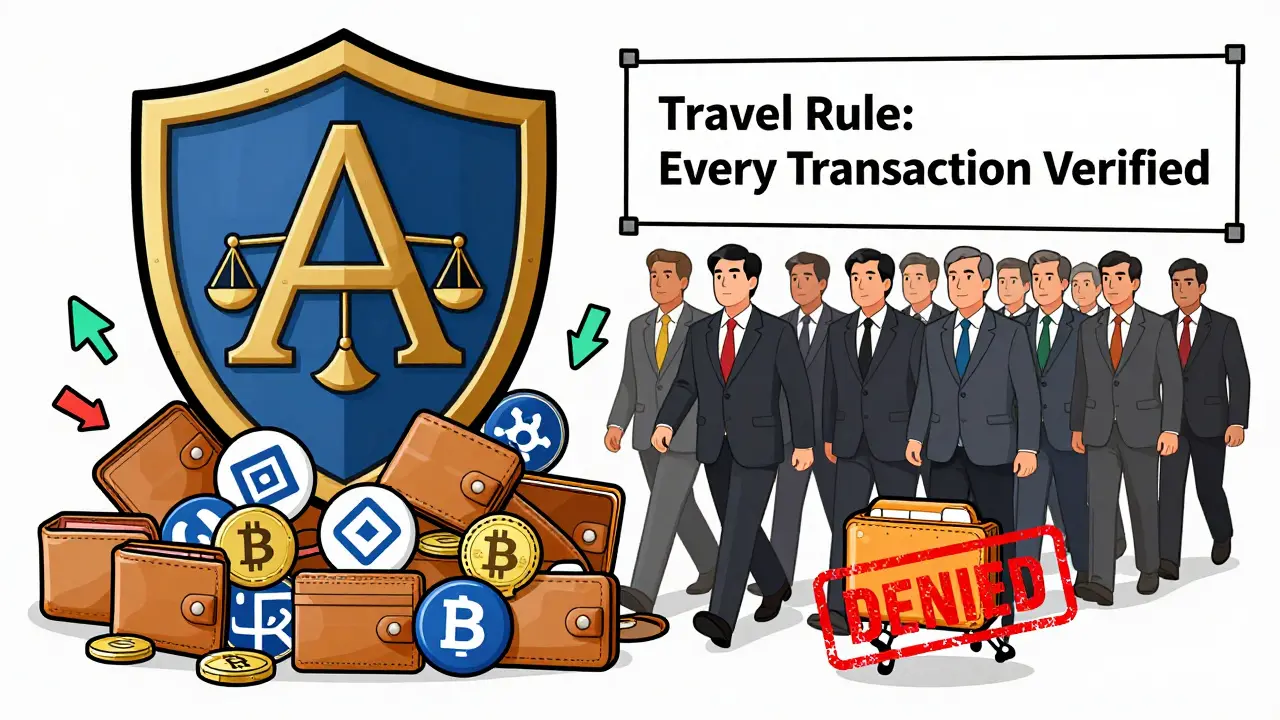
- The Travel Rule - This is where the EU goes further than anywhere else. Unlike the U.S., which only requires data sharing for transfers over $3,000, the EU demands full originator and beneficiary information for every crypto transaction. That means you need to collect and verify: name, account number, physical address (or date of birth), and for the recipient, the same details. Even transfers to self-hosted wallets (like MetaMask) require verification if they exceed €1,000.
- Reporting Suspicious Activity - If something smells wrong, you report it. Not when you’re sure it’s illegal. Not when you have proof. Just when it looks odd. You send Suspicious Activity Reports (SARs) to your national Financial Intelligence Unit (FIU). In 2025, EU regulators received over 12,000 SARs from crypto firms-up 300% since 2022.
- Internal Controls - You need a designated Money Laundering Reporting Officer (MLRO), written AML policies, staff training, and audit trails. Compliance isn’t a checkbox. It’s a full-time job.
The New Boss: AMLA
Before 2025, each EU country handled crypto AML compliance on its own. That meant a firm in Germany faced different rules than one in Spain. Now, the Anti-Money Laundering Authority (AMLA) runs the show. Launched in early 2025, AMLA coordinates all national supervisors and has direct power to investigate, fine, or shut down non-compliant firms-even if they’re registered in a different country.
AMLA’s first major move? A coordinated audit of all 217 licensed CASPs in the EU. Their focus? Travel Rule implementation and beneficial ownership. In early 2026, they fined a Dutch-based exchange €14 million for failing to verify 18,000 transactions to self-hosted wallets. The message is clear: no more loopholes.
How Much Does It Cost?
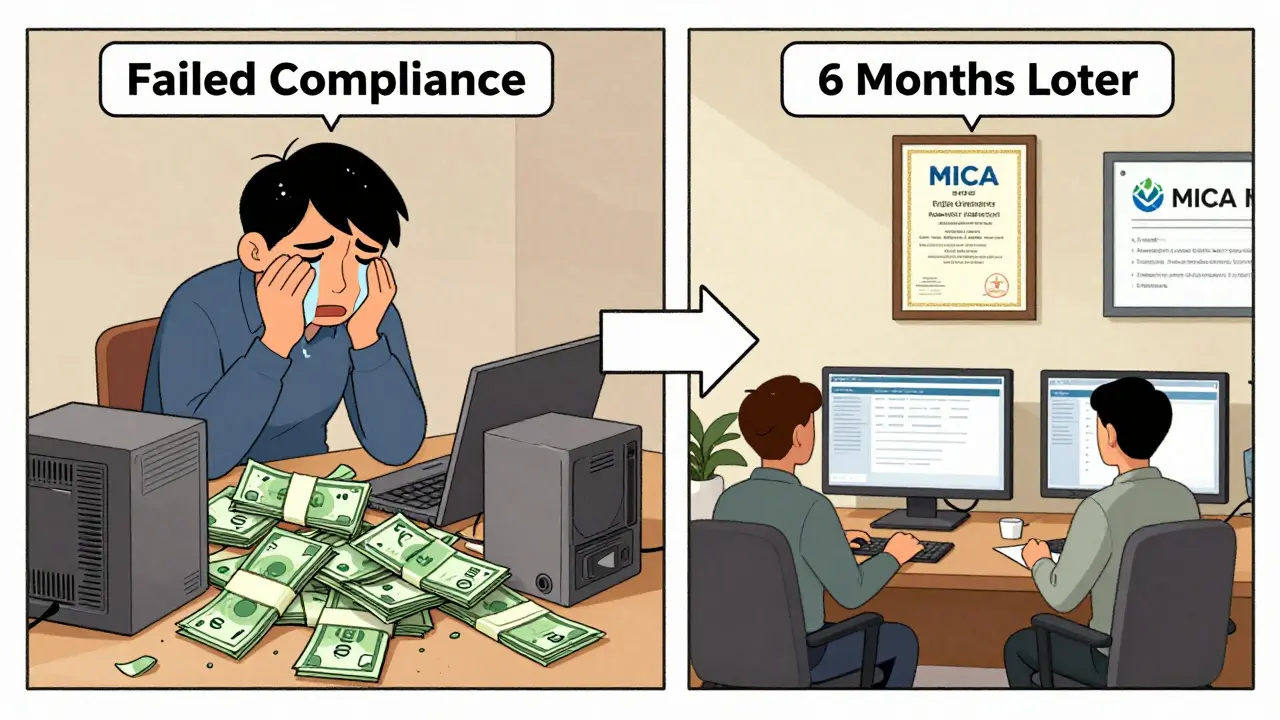
Getting licensed under MiCA isn’t cheap. According to ESMA’s 2025 data, the average cost to set up full compliance is between €350,000 and €500,000. That includes legal fees, software integration, hiring compliance staff, and training. For smaller firms, it’s often a dealbreaker.
One startup founder in Lisbon told CoinDesk: “We spent six months and €420,000 just to connect to the German and French FIUs. We didn’t even get to launch.”
But there’s a silver lining. Once you’re licensed under MiCA, you can operate across all 27 EU countries without needing separate approvals. That’s a massive reduction in complexity compared to pre-MiCA days. Coinbase reported a 70% drop in operational overhead after getting their EU license.
What About DeFi?
DeFi is the blind spot in the EU’s system. Most protocols-like Uniswap or Aave-have no central company, no CEO, no legal entity. That means they don’t fit the CASP definition. But criminals are using them anyway.
The German financial watchdog BaFin documented over 20 cases in 2025 where launderers used DeFi bridges to move illicit funds between chains. The EU doesn’t have rules for these yet. AMLA says it’s working on guidance for 2026, but for now, if you’re building a DeFi tool, you’re on your own. Many firms are avoiding the EU entirely until clarity arrives.
How Does This Compare to the Rest of the World?
Compared to the U.S., the EU is far more consistent. In America, you might need approval from FinCEN, state regulators, and the SEC-all at once. In the EU, one license covers you everywhere.
But the EU is also more aggressive. The Travel Rule applies to every transaction. The U.S. ignores small transfers. The EU doesn’t allow anonymous transactions. Switzerland still lets users trade with pseudonyms. The EU says no.
That’s why many firms are leaving. Binance stopped serving customers in five EU countries in 2024. Kraken moved its compliance team from Luxembourg to the U.K. after Brexit. The cost of compliance is pushing innovation out of Europe.
What’s Coming Next?
On July 1, 2027, the new EU-wide AML Regulation kicks in. It will replace all previous directives and create a single rulebook. Here’s what changes:
- Crypto firms must respond to FIU requests within five working days (currently varies by country).
- Any business accepting cash payments over €3,000 must verify the source of funds.
- A cap of €10,000 on cash payments for business transactions.
- Expanded scope: now includes professional football clubs, crowdfunding platforms, and high-value art dealers.
- Strict new rules on privacy coins: Monero, Zcash, and similar assets will be treated as high-risk.
AMLA has already said it will start blocking access to privacy-enhancing tools in 2026. If you’re using mixers or privacy wallets, you’re at risk of being frozen out.
Real Consequences
Non-compliance isn’t a slap on the wrist. In 2025, the EU fined six crypto firms over €100 million combined. One Estonian firm was shut down after processing €187 million in transactions through a Gibraltar shell company. Another was banned from operating in France for failing to verify 40,000 users.
And it’s not just fines. Your bank can cut you off. Your payment processor can refuse service. Your customers will leave if they think you’re risky. In 2025, 89% of institutional investors only worked with MiCA-licensed firms. The market is rewarding compliance-and punishing the rest.
What Should You Do Now?
If you’re already operating in the EU:
- Confirm you have a MiCA license. If not, you’re illegal.
- Verify your Travel Rule setup. Are you collecting all six data fields for every transaction?
- Check your KYC system. Are you doing enhanced due diligence for transactions over €1,000?
- Train your team. ESMA requires 40 hours of AML training per year for compliance staff. Document it.
- Prepare for AMLA’s 2026 audit. They’ll look at your logs, your reports, your ownership structure.
If you’re planning to enter the EU market:
- Start the MiCA licensing process now. It takes 9-12 months.
- Use proven middleware like Traveler or Chainalysis to handle Travel Rule compliance. Don’t build it yourself.
- Factor in €500,000+ in setup costs. If you can’t afford it, reconsider your EU strategy.
- Don’t try to game the system. Forum shopping (registering in a lax country) is being actively hunted by AMLA.
The EU isn’t going away. The rules aren’t changing. They’re getting harder. The firms that survive are the ones that treat compliance as part of their product-not a cost center.
Do I need a MiCA license if I only serve non-EU customers?
Yes, if any of your users are based in the EU. The EU regulates based on where the customer is, not where your company is registered. Even if you’re based in the U.S. or Singapore, if an EU resident uses your platform, you must comply with MiCA and AML rules. Ignorance isn’t a defense.
Can I use a third-party provider for KYC and AML checks?
Yes, but you can’t outsource responsibility. You can use services like Onfido, Jumio, or Chainalysis to handle identity verification or transaction monitoring, but you remain legally liable. If they miss something, you get fined. Make sure your provider is certified under EU standards and keeps audit logs.
What happens if I don’t comply?
You’ll be fined, banned from operating in the EU, and possibly criminally prosecuted. Fines can reach up to 5% of your annual turnover or €5 million-whichever is higher. Your bank accounts may be frozen. Payment processors like Stripe or PayPal will cut you off. And your reputation will be destroyed. In 2025, three crypto firms went out of business after failing to comply.
Are privacy coins banned in the EU?
Not officially banned, but they’re treated as high-risk. Exchanges must apply enhanced due diligence to every transaction involving Monero, Zcash, or similar coins. Many firms have stopped supporting them entirely. AMLA plans to issue formal guidance in Q1 2026 that could lead to outright restrictions.
Is there a way to avoid MiCA compliance costs?
Not legally. Some firms try to register in non-EU countries and claim they’re not subject to EU rules-but if they serve EU customers, regulators will still come after them. The only real way to reduce costs is to scale up. Larger firms get better rates on compliance software and can spread fixed costs across more users. Smaller firms are being squeezed out. That’s the reality of the EU market in 2026.
The EU has made its stance clear: crypto can exist here, but only if it plays by the rules. There’s no room for ambiguity, no shortcuts, and no exceptions. If you’re serious about operating in Europe, compliance isn’t optional-it’s your foundation.
5 Comments
Okay but like… can we just appreciate how wild it is that the EU is actually making crypto *work* instead of just banning it? 🙌 I’ve seen so many places try to crush it or ignore it, but this? This is adulting. Yes, it’s expensive. Yes, it’s a headache. But now you know exactly what you need to do, and if you’re legit, you can operate across 27 countries with one license. That’s not oppression-that’s infrastructure. I’m lowkey impressed.
so like… the travel rule for EVERY transaction?? like even if i send 5 euro to my friend to split a pizza?? bro that’s not compliance that’s just… dumb. theyre gonna turn every wallet into a surveillance tool. and dont even get me started on privacy coins. monero is literally designed for this. if you ban it you just push it to the darknet. duh.
People complaining about costs? 😂 Get real. You’re not a startup-you’re a financial institution. If you’re handling other people’s money, you owe them safety. Period. I don’t care if you’re ‘innovating’-if your tech is being used to launder drug money, you’re part of the problem. AMLA is doing God’s work. The fact that firms are leaving? Good. Let the crooks and cowboys go. The real players? They’ll thrive under this. And if you can’t afford €500k? Then maybe you shouldn’t be in this space. Simple.
I’ve been watching this whole situation unfold for years, and let me tell you-I’m not just disappointed, I’m emotionally exhausted. The EU doesn’t understand that crypto is about freedom, about decentralization, about removing intermediaries-and instead, they’ve built the most bureaucratic, soul-crushing, over-regulated, paperwork-heavy, compliance-obsessed monster the world has ever seen. Every single transaction? Every single wallet? Every single time someone sends a single satoshi? It’s all logged, tracked, flagged, audited, reported, and then reviewed by some overworked bureaucrat in Brussels who’s never even held a private key. And don’t even get me started on the fact that they’re going after privacy coins-like Monero is the villain here? It’s the *only* thing that protects ordinary people from state overreach! And now they’re calling it ‘high-risk’? What’s high-risk? Being able to keep your financial life private? That’s not a risk-that’s a right! And now they’re banning it? This isn’t regulation. This is tyranny dressed up in a suit. I’m not angry. I’m heartbroken.
This is very well written. The information is accurate. The structure is logical. The regulatory framework is clearly explained. One must acknowledge the seriousness of the matter. Compliance is non-negotiable. The EU has demonstrated institutional clarity. The cost is substantial. The consequences of non-compliance are severe. The future is regulated. There is no alternative.